Waverley Redevelopment Approvals: Uniting Estate Lessons
What Uniting Waverley Estate teaches developers about getting big approvals over the line
Seniors housing in NSW has gone from niche to nation-building. The over-75 population is the fastest-growing age group in the state, yet supply has not come close to keeping up, and that mismatch is now actively shaping planning policy and consent decisions at the state level.
Which is why the Uniting Waverley Estate redevelopment at 125 Birrell Street, Waverley, right next to Bondi Junction, is worth paying attention to, whether you are in the eastern suburbs or not.
Approved in February 2026 via the State Significant Development Application (SSDA) pathway, this is a $500 million transformation of a 3.4-hectare estate delivering 231 independent living apartments (including 23 affordable units), 105 residential aged-care places, and keeping the War Memorial Hospital running throughout construction. Seven buildings, four to seven storeys, staged across a constrained, heritage-sensitive site with a live hospital in the middle.
Here is what Waverley teaches us about approvals strategy, stakeholder management, and building on operational land.
1. Treat the SSDA pathway as a strategy, not a formality
The biggest lesson from Waverley is that this approval was engineered over time, not won in a single determination. The project reportedly took a nine-year pathway from inception to consent. That is increasingly normal for complex, high-value sites where heritage, neighbours, and operational constraints all collide.
At $500 million across seven buildings, the SSDA pathway was a practical necessity. But it also became a commercial advantage. SSDA assessment is state-led, and the policy tailwinds for seniors housing helped carry the project through issues (affordable housing percentages, tree removal, construction disruption) that would typically derail a standard local DA at Waverley Council.
Uniting framed the whole narrative around public benefit:
"This accommodation helps older people stay independent for longer, delays the need for higher-level care, and frees up family homes for others during a housing crisis." -- Tracey Burton, Chief Executive, Uniting NSW.ACT
That framing matters. When your project aligns with state priorities (housing supply, ageing population, critical infrastructure), the consent authority has a reason to push through contested issues rather than refuse on the path of least resistance.
Bottom line: If you are pursuing a major seniors, health, or precinct-scale project, build your DA strategy around state priorities and measurable public benefit. And budget for a multi-year pathway as a baseline assumption, not a worst case.
 Heritage gardens retained alongside new residential buildings. Design by Architectus and Welsh + Major.
2. Lock in operational continuity early, or staging will run your project
This is not a "build vacant, then operate" project. It is operate-while-building. The approval retained the War Memorial Hospital and existing health services, which means construction staging is not just a scheduling exercise. It is a risk system that governs safety, access, noise, services continuity, and reputation.
That complexity compounds because Waverley is not a simple retirement village. It is a mixed, integrated precinct delivering 336 total accommodation outcomes (231 ILUs + 105 aged-care places), plus community uses and open space. At roughly $1.49 million per unit ($500M / 336), that reflects eastern suburbs land costs plus the significant premium of working around a live hospital and heritage fabric.
This is where stakeholder management goes from theoretical to deeply practical: hospital operations, clinicians, existing residents, visitors, emergency vehicle access, and service contractors all need to be built into the construction methodology and the comms plan. Miss one of those and you have an ambulance blocked by a concrete truck on the front page of the Wentworth Courier.
"Enhanced community services and facilities, increased green spaces available to residents and the community, and landscaped sensory gardens are all part of the newly-approved $500 million redevelopment." -- Simon Furness, Director of Property and Housing, Uniting NSW.ACT
Bottom line: For operational sites, develop a staging masterplan before detailed design is locked in. Decanting, temporary works, infection control, access routes, and service cutover plans all need to be priced, documented, and tested with stakeholders early, not bolted on at CC stage.
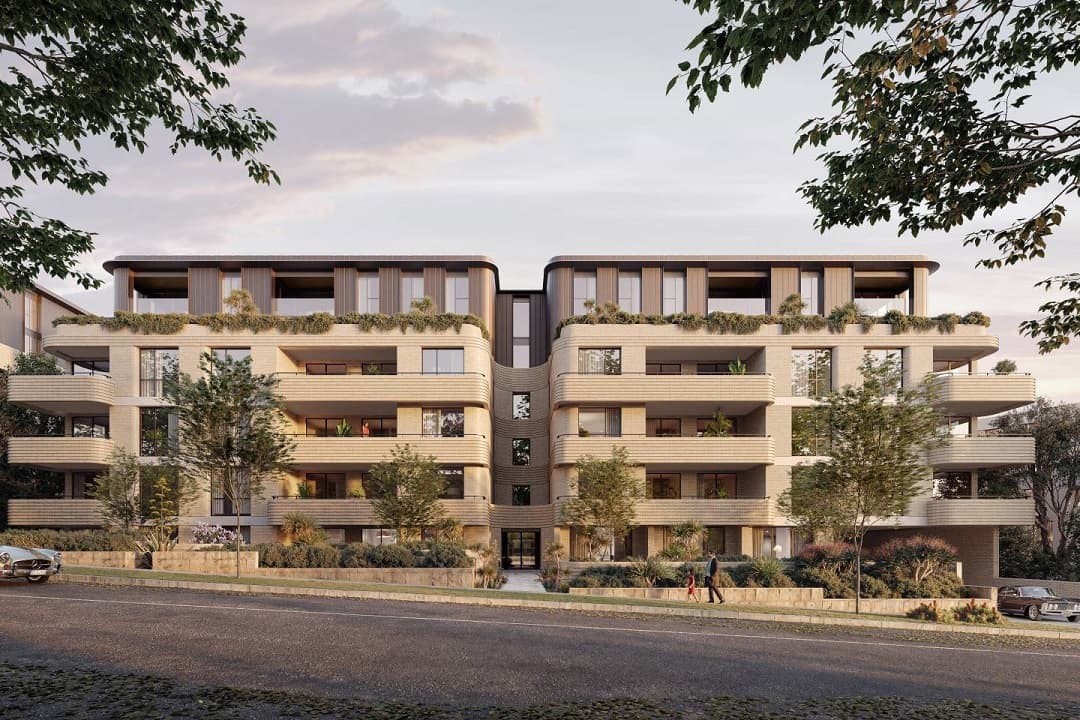
 New residential building balancing contemporary form with the established streetscape character.
3. Heritage is powerful approval leverage, but manage the cost reality
The eastern suburbs planning environment is unforgiving on bulk, scale, and neighbourhood character, especially where heritage streetscapes and established communities meet mid-rise density. Waverley's scheme handled this by pairing contemporary form with a genuine conservation story: four heritage-listed cottages retained and restored, designed by Architectus and Welsh + Major, with landscape architecture by Arcadia.
This does two things at once. First, it creates an approvals narrative around adaptive reuse and continuity of place, giving the assessment panel something positive to anchor to. Second, it gives community stakeholders something tangible to support, even if they are opposing other elements like height or construction impacts.
"The seven buildings each balance heritage sensitivity with contemporary form." -- Tracey Burton, Chief Executive, Uniting NSW.ACT
The commercial catch? Heritage is rarely free goodwill. Retention and restoration add programme time, latent conditions risk, and cost uplift, particularly when layered on top of staged construction around a live hospital. That is exactly why feasibility for seniors housing varies so dramatically: Waverley comes in at roughly ~$1.49M/unit compared to Uniting's Belrose approval at ~$750K/unit. Location, heritage, and integration complexity roughly double the cost base.
Bottom line: Treat heritage retention as a dual-track workstream: (1) approvals leverage and (2) delivery risk. Price it transparently in feasibility, and get early contractor and heritage consultant input to flush out latent-condition surprises before you are locked into a program.
4. Don't bolt affordable housing on at the end; bake it into yield logic
Affordable housing is now a baseline expectation in most NSW approval environments for large precinct-scale proposals. At Waverley, the project includes 23 affordable housing units within the 231 ILUs, which triggered stakeholder debate not just about the percentage, but about the method of calculation: unit count versus Gross Floor Area.
That distinction matters because it directly influences design efficiency, apartment mix, and financial outcomes. The community was direct about it:
"Our major objection relates to affordable housing and the need for more accessible and affordable units to serve Waverley's aging population. Unfortunately Uniting is only offering 10% however we believe this is insufficient given the lack of affordable housing and poor 'community compensation' for the impact of the build on a constrained site." -- Community Submission, NSW Planning Portal
From a developer's perspective, the practical lesson is that affordability debates are largely predictable, and therefore pre-manageable. You need a clear position tied to: eligibility criteria, allocation and management model, dwelling typologies, and how it integrates with the operating model. If you leave the affordable housing conversation to the exhibition period, you will spend the rest of the approval defending a number someone else chose for you.
Bottom line: Define your affordable housing position early, including whether it is GFA-based or unit-based, and align it with the operating model. Stakeholder scrutiny will test the numbers, not the intent.
 Retained mature trees and landscaped courtyards designed for resident wellbeing and community use.
5. Expect environmental objections; respond with measurable trade-offs
On constrained urban sites, "green" issues are never abstract. Waverley attracted significant concern about the planned removal of 95 trees, even as Uniting committed to a net-positive green space outcome with expanded communal landscapes: sensory gardens, courtyards, and intergenerational spaces.
This is where stakeholder management needs to shift from reassurance to hard evidence. Environmental stakeholders, and increasingly consent authorities, want clear documentation: tree audit methodology, retention rationale, replacement ratios, canopy cover targets, deep soil zones, and how landscape outcomes are protected during staged construction.
On a live precinct supporting older residents and health services, landscape is not just aesthetic. It affects thermal comfort, wayfinding, wellbeing, and social licence during a four-year construction program. The way you sequence landscaping and public realm delivery can materially shape community sentiment across the whole build.
Bottom line: Convert environmental objections into a quantified package: publish canopy outcomes, replacement commitments, and staged landscape delivery milestones. Then keep reporting consistently during construction to protect trust.
 Indicative masterplan showing the full precinct layout, heritage buildings, and landscaped open space.
Wrapping up
The Uniting Waverley Estate story shows that getting big approvals over the line in the eastern suburbs is not about "winning" individual objections. It is about building a development narrative that aligns with state priorities, then executing with credible staging, measurable community benefit, and disciplined stakeholder management across the full approval and delivery timeline.
It also reinforces a market reality: seniors housing is now being assessed and supported like critical infrastructure. When a project can demonstrate genuine need (fast-growing over-75 cohort), tangible outcomes (231 apartments + 105 aged-care places), and operational continuity (the hospital stays open), the approval pathway becomes achievable, even on a heritage-sensitive, heavily scrutinised site.
If you are working on a similar project, the key takeaways:
- Plan for time: complex sites can take years. Waverley took nine. Structure funding, governance, and consultant scopes accordingly.
- Stage around operations: live-site continuity should drive programme logic, budget, and risk registers, not sit in an appendix.
- Quantify trade-offs: affordability, trees, and public benefit need transparent numbers, not slogans.
UpScale PM specialises in project feasibility, DA strategy, and premium project delivery. Call us on 02 9090 4480 to chat through your site opportunity.

Director, UpScale Project Management
Registered architect (NSW) and client-side project manager with more than 15 years across architecture practices, client-side project management consultancies and government agencies. Noel founded UpScale PM to provide independent, client-side project management for NSW club boards navigating major redevelopments.
Related insights
AS4902 vs AS4000 for Club Redevelopments
AS4000 is construct-only, AS4902 is design and construct. What each form means for a club board: design risk, novation, time, variations, security and payment.
Separable Portions Explained for Club Boards
Separable portions let a club take back and trade in finished areas while building continues. How they work, and the drafting traps boards should avoid.
Sydney Hotel Development Feasibility: Brand Deal Shifts
Sydney hotel development feasibility is changing with brand standards, operator agreements and FF&E capex. Stress-test your deal model — talk to UpScale PM.
Corrimal Coke Works: 850 Homes and the Remediation Reality
Corrimal Coke Works shows how TOD uplift, brownfield remediation and SSD staging shape feasibility risk. UpScale PM breaks down the delivery lessons.