The Shellharbour Club: Industrial Heritage Meets Modern Club Design
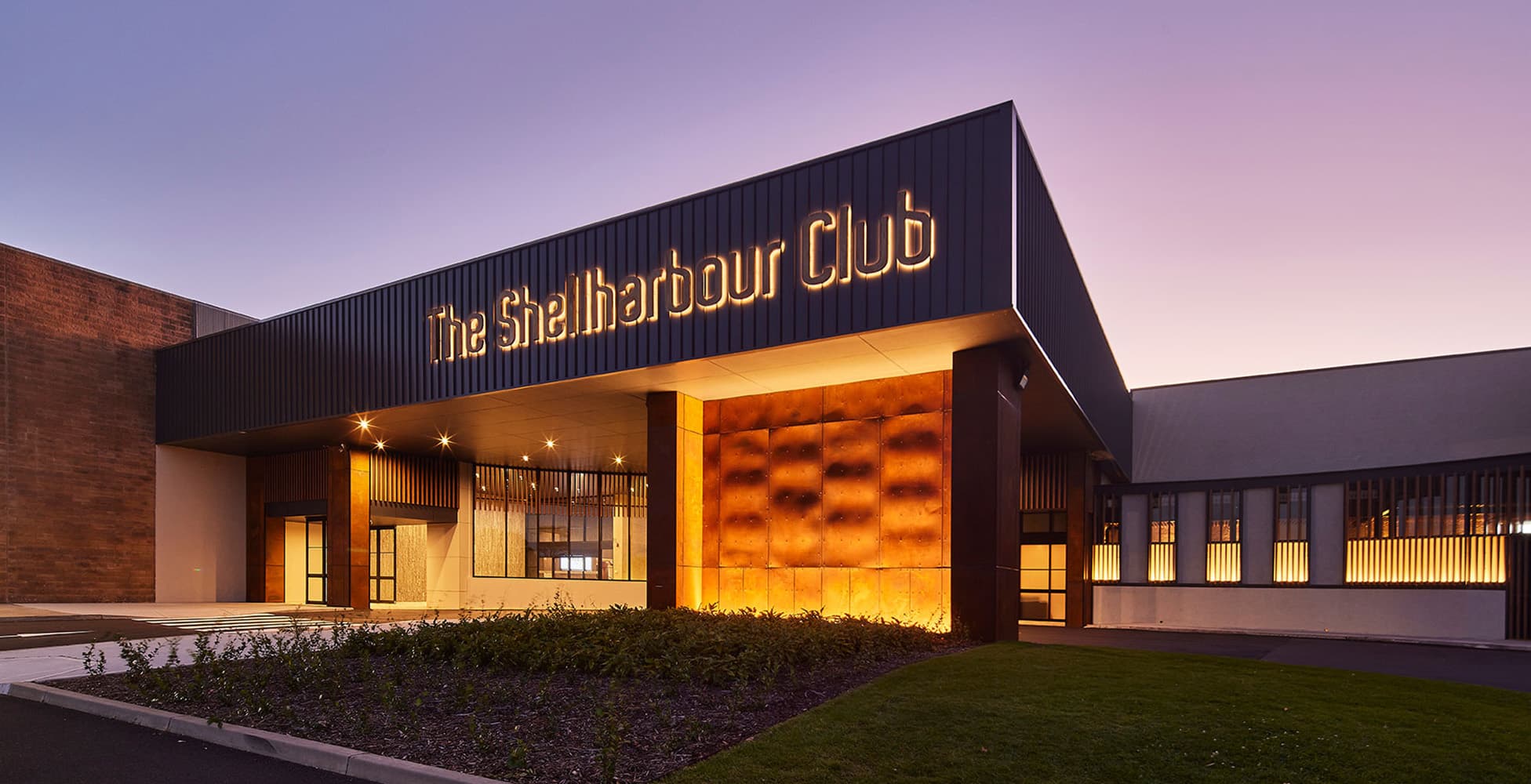
The Shellharbour Club sits on a generous site in the heart of the Illawarra, backed by open playing fields and looking out toward the coast. For years it served its 26,000-plus members reliably. But like many regional clubs, the building had started to lag behind what people expected from a night out or a family dinner. The facilities worked, but they didn't excite anyone.
Between 2023 and 2024, the club delivered a comprehensive redevelopment designed by Altis Architecture that touched almost every public-facing part of the building. A tired auditorium became a street-food precinct. The gaming floor was rethought from scratch. A new southern facade gave the club a presence it hadn't had before. And they did it all without shutting the doors.
The scope: 2,500 square metres transformed
This wasn't a cosmetic refresh. The project delivered roughly 1,500 square metres of new and renovated food and entertainment space, plus approximately 1,000 square metres of redesigned gaming facilities accommodating 248 machines.
The headline components:
- The Precinct — a 1,500 sqm street-themed food and entertainment destination converted from the existing auditorium, featuring multiple street food vendors, casual dining, and Block House (a dedicated kids' entertainment area with slides and interactive play spaces)
- Gaming floor redesign — 248 machines repositioned with significantly greater spacing, custom-designed privacy screens, and a VIP gaming lounge
- New southern facade — corten steel, raw concrete, Colorbond cladding, and patterned glass creating a bold new street presence
- Redesigned main entry — a completely reimagined arrival experience
- New dining venues — including Lido Cafe Pizza Kitchen, Fiftysix Dining brasserie, a Sports Bar with an 8.5m x 4.5m LED screen, Lounge Bar, and Velvet Bar
- Amenity upgrades — new bathrooms, smokers' terrace, renovated snooker room, and new staff room
It's a lot of ground to cover in one programme. The fact that it was delivered across a phased schedule while the club stayed open makes the logistics more impressive than the square metres suggest.
The people
CEO Jason Petrolo, promoted from General Manager to CEO during the project, led the executive side of the delivery. The board, led by Vice President Brian Goodall (a Life Member since 2018 with governance and financial management qualifications), provided oversight alongside directors Luke McPhie, Scott Murphy, Peter Cooper, Patrick Shortall, and Lupcho Mazevski. Several board members completed formal training in corporate governance, strategic planning, risk management, and procurement. That kind of upskilling pays dividends when you're overseeing a multi-million dollar capital project.
Design: steel town, not generic club
This is where The Shellharbour Club's redevelopment stands apart from a lot of club refurbishments.
Altis Architecture drew directly from the Illawarra's steel manufacturing heritage to develop the material palette. The region built its identity around heavy industry (Port Kembla steelworks is just up the road) and the design team used that history as a starting point rather than reaching for the same coastal-casual playbook every NSW club seems to default to.
The result is a material language built on corten steel (the weathering steel that rusts to a warm orange patina), raw concrete, patterned glass, glass bricks, and burnished metal finishes. It's industrial without being cold. The corten panels on the main entry glow under uplighting at dusk, and the raw concrete walls along the southern facade give the building the kind of visual weight that says "this place has been here a while and it's not going anywhere."
The gaming room design is worth a closer look. Altis worked with Capital Design Works to create custom screens that serve as machine dividers, not plain boards, but bespoke patterned panels combining multiple design influences. The design intent was to improve the room's spatial quality and what the team described as its "feng shui." Whether or not you buy into that language, the practical outcome is clear: a gaming floor where 200 people can occupy the space without feeling hemmed in.
The Precinct: turning an auditorium into a street market
The boldest move in the programme was converting the existing auditorium into The Precinct — a 1,500 sqm indoor street-food and entertainment destination.
Rather than demolish and rebuild, the design team repurposed the auditorium shell and filled it with street food vendors (Dynasty Dumplings, BFS Burgers, a dedicated sweets shop), casual dining, and Block House — a kids' play area built from brightly coloured shipping containers with slides and interactive spaces. It operates Wednesday through Sunday with performers on Friday nights.
The concept borrows from the street-market energy that's driven hospitality trends in capital cities, but applies it in a regional club context. It's the kind of adaptive reuse that's smart for two reasons: it preserves the existing structure (saving time and money on demolition and new build), and it creates a genuinely different experience from the traditional club bistro format.
Staging: staying open while building
The club maintained operations throughout construction by isolating work zones from public areas. The major phases ran roughly as follows:
- July 2023 — steelwork and metalwork commenced (Illawarra Steelworks, $260k contract via Boden Projects)
- Late 2023 to early 2024 — southern facade, entry, and amenity works progressed
- March 2024 — Southern Section Project completed
- Late April 2024 — new southern areas opened to members
- June 1, 2024 — gaming room reopened after an intensive final installation push
That last point is telling. The gaming room completion came down to the wire, with the Capital Design Works team working around the clock in the final week to hit the reopening date. This happens regularly in live-site club refurbishments. The programme compresses at the end because you're working around an operating venue, and the final push often looks nothing like the neat Gantt chart you started with.
The financial impact was manageable. The club posted a profit after tax of $1.47 million in the 2024 financial year (ending June 30), down from $3.02 million the prior year. That dip reflects the disruption you'd expect during a major build, but the underlying business clearly remained solid. The club also contributed over $400,000 to community organisations through ClubGRANTS during the same period, part of more than $1.8 million in community contributions over the preceding five years.
The Project Team
| Role | Firm |
|---|---|
| Architect | Altis Architecture |
| Head Contractor / Project Manager | Boden Projects |
| Structural Steelwork | Illawarra Steelworks |
| Precinct Fitout | Event Engineering |
| Gaming Room Screens | Capital Design Works |
| Client | The Shellharbour Club |
What changed: before and after
The gaming room tells the story most clearly. Before the redevelopment, machines were packed tightly with plain backing boards and minimal separation. After, 16 machines were removed entirely to create wider banks, greater privacy, and custom-designed screens between positions. The room went from cramped to comfortable — and the club reports that the new layout has been a genuine hit with members.
The broader transformation repositioned The Shellharbour Club from a facility that was functional but dated into something that gives members a reason to visit beyond habit. Multiple dining venues, the Precinct, the redesigned entry, and the new facade collectively changed the club's identity in the community.
The southern facade works are positioned as the first phase of a longer-term plan to update the entire building exterior — a sensible approach that locks in the design language now and extends it as budgets allow.
Key Takeaways for Club Boards
-
Let your region tell the design story. The Illawarra's industrial heritage gave Altis Architecture a genuine narrative to work with. Corten steel and raw concrete aren't just aesthetic choices — they connect the building to its community. Every region has a story. The best club refurbishments find it and use it.
-
Rethink your underperforming spaces. The auditorium-to-Precinct conversion is a masterclass in adaptive reuse. If your club has an underused function room or auditorium, consider what it could become rather than what it's always been.
-
Gaming room design is more than machine count. Removing 16 machines to improve spacing sounds counterintuitive, but the result is a room where people actually want to spend time. Comfort and privacy drive dwell time, and dwell time drives revenue.
-
Stage to protect revenue, then be honest about the dip. The club's profit halved during the construction year — and they still posted a $1.47 million surplus. Staging kept the doors open, and transparency with members kept confidence high.
-
Invest in board capability. Multiple Shellharbour Club directors completed formal training in governance, finance, strategic planning, and procurement. That's not a box-ticking exercise — it's how boards make informed decisions on projects of this scale.
At UpScale, we're currently managing the Granville Diggers Club redevelopment — another project navigating staged delivery, live-site construction, and the particular governance challenges that come with club capital works. If your board is considering a redevelopment, get in touch. We help clubs navigate the full process from concept through to completion.

Director, UpScale Project Management
Architect-turned-project manager with experience across government infrastructure, commercial, and hospitality sectors. Noel founded UpScale PM to provide independent, client-side advisory for club boards navigating major redevelopment projects across NSW.