Gosford RSL: How a $50M Rebuild Reshaped the Central Coast
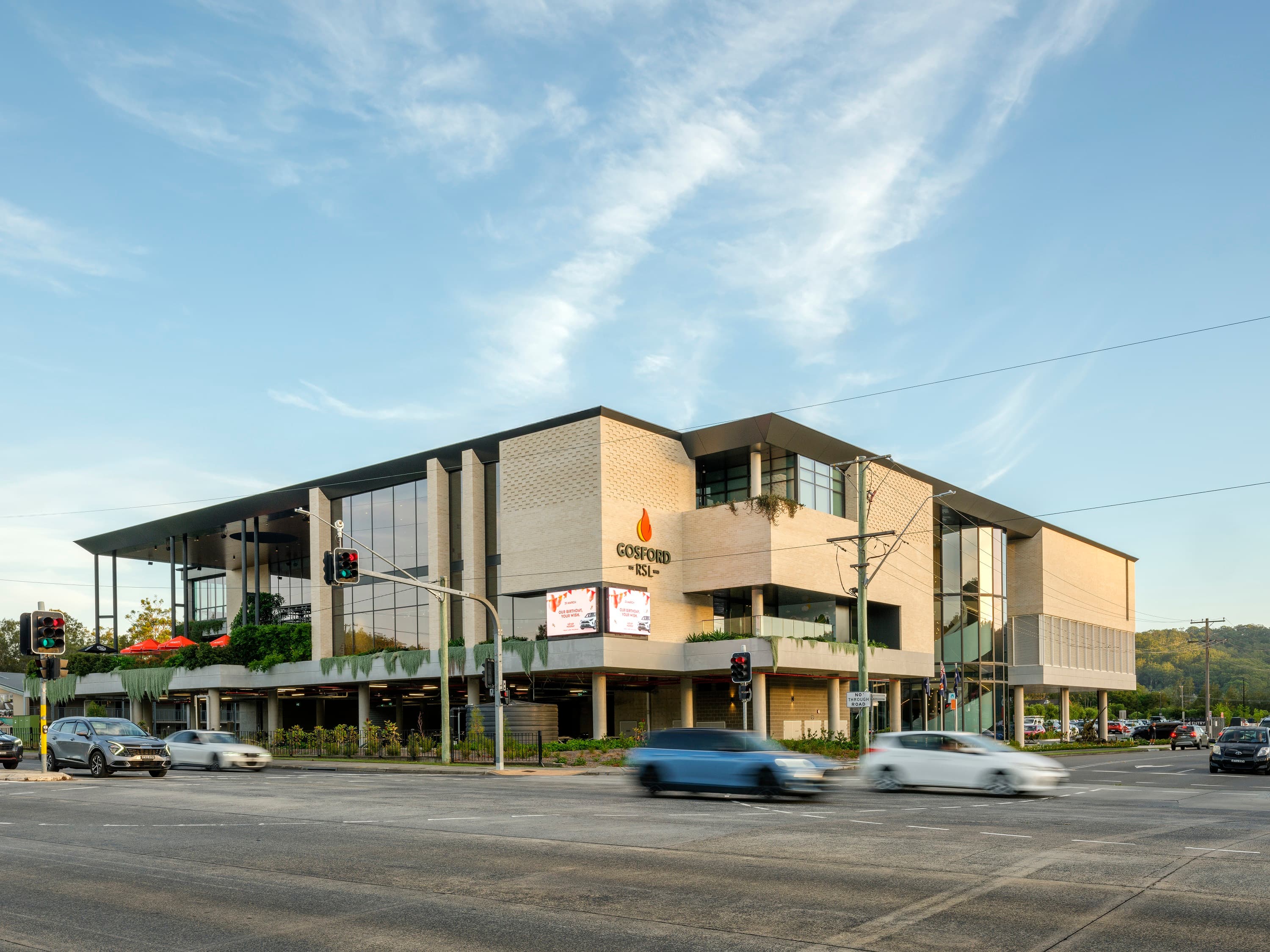
Some club redevelopments are renovations. Gosford RSL's was a reinvention. After more than six decades on the same West Gosford site, the club didn't just refurbish what it had — it built an entirely new three-storey venue from the ground up, on the front car park, while the old club kept trading behind it.
The result is a $50 million superclub that opened to the public on 27 March 2024, two years after construction began. It's now one of the most ambitious club redevelopments completed in regional NSW, and a case study in what's possible when a board commits to a long-term vision and assembles the right team to deliver it.
The vision: a gateway building
Gosford RSL has operated since 1960, originally formed after World War II to provide a meeting place for returned servicemen and women. By the 2010s, with over 25,000 members, the board recognised the existing building was no longer fit for purpose. A $4.5 million renovation in 2006 had extended its life, but the facilities couldn't compete with what members increasingly expected from a modern hospitality venue.
After reviewing multiple options, the board decided to build an entirely new club rather than patch the old one. They wanted a landmark building, one that would mark the gateway to Gosford and the Central Coast from the busy Central Coast Highway.
WMK Architecture was selected to develop a masterplan for the entire site. The masterplan encompassed not just a new club, but the potential for commercial offices, conferencing facilities, an indoor sports facility, and residential apartments. The new club building was phase one.
The people
CEO Russell Cooper drove the project from inception, working with the board through years of planning and the delays caused by the pandemic. Cooper's leadership kept the project moving when COVID pushed the original 2020 construction start back by two years.
John Andreas, Director at WMK Architecture, led the design. His brief was to create a building that was both elegant enough for its prominent highway address and durable enough to serve the community for decades.
The builder, North Construction & Building, is a Central Coast firm — a deliberate choice by the club to keep the economic benefits local. Managing Director Matthew Cook oversaw delivery, navigating significant design challenges that emerged after construction commenced.
The APP Group provided project management services across the full lifecycle, from business case and feasibility through to construction delivery.
Planning and approvals
The development application was lodged in April 2018, proposing a staged development on the site at 2-20 Yallambee Avenue, West Gosford. The proposal extended the club to approximately 6,800 square metres of floor area — a significant increase over the existing footprint.
The DA was structured in two stages:
- Stage 1: Construction of the new club building, including car parking underneath
- Stage 2: Demolition of the existing club and formation of a 154-space at-grade car park, to be completed within six months of occupying the new building
Given the scale and the site's position on a major highway, the application was determined by the Central Coast Regional Planning Panel rather than council alone. DA approval was granted for what was then a $32 million project — a figure that would grow substantially as the design was refined and market conditions shifted.
The design: coastal, not corporate
WMK's design draws directly from the Central Coast landscape. The building is a composition of masonry and glass that opens to the north and east toward Narara Creek, surrounded by lush landscaping that anchors it to its setting.
The interior palette combines warm coastal colours, natural textures, and local material references. The brickwork from the exterior is carried through into internal feature walls — a design move that gives the building coherence and a modern twist on a retro architectural element. Concrete finishes are varied throughout, and the greenery woven into the spaces reinforces the connection to the coastal landscape outside.
One of the more interesting design features is the way the building appears to "float" at ground level. The first-floor concrete slab extends beyond the supporting columns, and landscaping conceals the understorey. It gives a sense of lightness despite the building's substantial footprint.
The layout across three levels is deliberately varied to give every member a space they're comfortable in:
Ground Floor — a grand porte cochere entry, the RSL museum (an initiative of the Gosford RSL Sub Branch commemorating servicemen from the Boer Wars to recent conflicts), and a reception servicing both the club and the adjoining motel.
Level 1 — The Gardens — a dynamic dining precinct and recreation hub for up to 1,000 people. It includes a cafe, bar, lounge, multiple indoor and outdoor dining options, a kids' play zone, and a teenage retreat. Five distinct culinary offerings give members genuine choice rather than a single bistro menu.
Level 2 — The Grandstand and The Gallery — a sports bar with multiple screens (including a massive 5x3 metre display), competition-sized snooker and billiard tables, and the Oak Haven Brewery, which started in 2018 and now has a permanent home. The Gallery conference and events centre can host up to 450 banquet-style or over 700 theatre-style, with the ability to subdivide for smaller functions.
Staging: building new while trading old
The staging strategy was central to the project's success. Rather than closing the club or attempting a live-site renovation of the existing building, the board chose to construct the new venue on the northern end of the site — the front car park facing the Central Coast Highway.
The existing club remained fully operational throughout the entire two-year construction programme. Members continued to access the old building via a temporary car park while the new structure took shape in front of them.
This approach had clear advantages: no lost trading days, no temporary relocations, and members could watch progress from the old club. But it required careful coordination. Access, parking, noise, and dust all had to be managed while keeping the member experience acceptable.
Once the new club opened and operations transferred, Stage 2 began — demolishing the old building to create the additional 154 car parking spaces needed to accommodate the expected increase in patron numbers.
Construction: what actually happened
Construction commenced in May 2022, with a groundbreaking ceremony attended by the board, WMK Architecture, North Construction & Building, and the broader consultant team. The original target was completion in late 2023.
The project hit challenges after construction began. As North's Matthew Cook acknowledged publicly, significant redesign was required mid-build, including a reduced footprint, changes to the internal layout, and alternate construction methodology. These are the kinds of issues that can derail a project without experienced teams and strong governance.
The tree-hoisting ceremony in mid-2023 — marking completion of all major structural works at 65% — signalled the project was back on track. The club opened to the public in March 2024, approximately six months later than originally anticipated but within a reasonable envelope for a project of this scale and complexity.
The final construction value landed at $50 million, up from the original $32 million DA estimate and the $45 million figure cited at construction commencement. That escalation reflects both scope evolution and the cost pressures that affected the entire construction industry through 2022-2024.
What was delivered
The numbers tell the story of the project's impact:
- 6,500 sqm of new floor space across three levels
- Five distinct dining offerings under one roof
- Conference and events centre for up to 700+ guests
- On-site brewery with dedicated bar
- 154 additional car parking spaces (post-demolition of old club)
- 50+ new staff hired for the opening
- Hundreds of construction jobs created during the build
The project injected millions into the Central Coast economy, with the deliberate choice of a local builder amplifying that impact.
The project team
| Role | Firm / Individual |
|---|---|
| Client | Gosford RSL Club |
| CEO | Russell Cooper |
| Architect | WMK Architecture (Director: John Andreas) |
| Builder | North Construction & Building (MD: Matthew Cook) |
| Project Manager | The APP Group |
| Photography | Steven Woodburn |
What boards can take away
Gosford RSL's redevelopment offers several lessons for any club board contemplating a major capital project:
-
Don't be afraid to start over. The board considered renovating the existing building but ultimately decided a new build would deliver better long-term value. That's a harder decision to make, but the result speaks for itself.
-
Plan for the whole site, build in stages. The masterplan covered everything from residential to commercial to sport — but the club came first. Having the bigger picture in mind shaped every design decision without requiring the board to commit to everything at once.
-
Keep trading through construction. Building new on an adjacent part of the site meant zero closure days. The financial impact of a two-year shutdown would have been devastating for a club of this size.
-
Choose local where you can. Partnering with North Construction & Building kept expertise and economic benefit on the Central Coast. It also meant the builder had a genuine stake in the outcome beyond the contract.
-
Expect the unexpected. Mid-build redesign is not unusual on projects of this scale. What matters is having the team and governance structure to manage changes without losing control of the programme or budget.
The project took seven years from the first masterplan to opening night. That's not unusual for a ground-up club redevelopment at this scale. What set Gosford RSL apart was the consistency of vision from the board and CEO, the quality of the design team, and the willingness to invest in a building that would change the club's trajectory rather than just patch its present.
At UpScale, we're currently managing the delivery of the Granville Diggers Club redevelopment, another club navigating staged construction, maintaining operations, and delivering a building their members will be proud of.
If your club is planning a redevelopment and wants independent project management advice, get in touch. We help boards navigate the process from feasibility through to completion.

Director, UpScale Project Management
Architect-turned-project manager with experience across government infrastructure, commercial, and hospitality sectors. Noel founded UpScale PM to provide independent, client-side advisory for club boards navigating major redevelopment projects across NSW.