Canterbury League Club: A $106M Redevelopment That Never Closed Its Doors
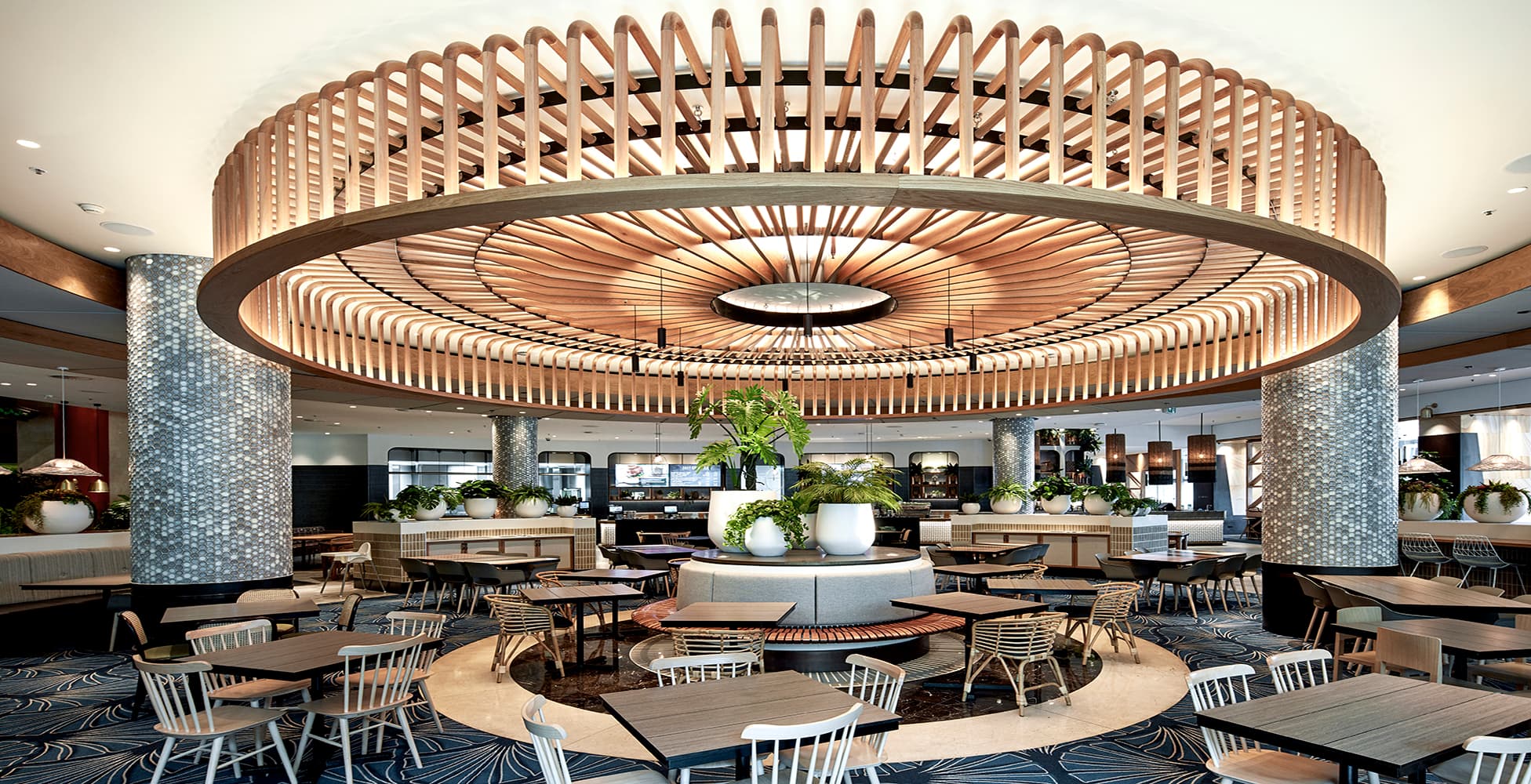
Canterbury League Club is one of those venues that makes you reconsider what a registered club can be. At 26 Bridge Road, Belmore, the home of the Canterbury-Bankstown Bulldogs has spent the better part of a decade and over $106 million transforming itself from a large suburban club into something closer to an integrated hospitality precinct, with five dining and bar venues, an 800-capacity showroom, a five-level underground car park, and a 24-hour cafe, all designed by Altis Architecture.
What makes the project remarkable is not just the scale. It is that the club never closed. Not for a day. The entire programme was delivered across multiple stages while Canterbury League Club continued to trade around the clock, seven days a week.
A club with history
Canterbury League Club opened on 6 June 1957 in a former Salvation Army hall on Collins Street, Belmore. The founding chairman was Frank Stewart, who later became Minister for Tourism and Recreation in the Whitlam Government and was instrumental in establishing the Australian Institute of Sport. The club started with 292 members and a room that held about 60 people on a busy night.
In 1960, the club acquired the former Paragon Theatre on Bridge Road for £17,000 and spent another £50,000 converting it into a proper club. That Bridge Road site has been home ever since. By the 1990s, Canterbury League Club had grown into one of NSW's most successful league clubs, eventually moving to 24-hour trading.
But by the early 2010s, the building, despite a significant millennium-era renovation, was struggling to keep pace with what members and the broader community expected from a modern hospitality venue. The board, led by President Peter Winchester, and CEO Greg Pickering, decided to undertake a comprehensive, multi-stage redevelopment that would touch virtually every part of the building.
The scale of the project
The redevelopment is estimated at $106-130 million and has been delivered across multiple stages from approximately 2014 through to 2024. It is not a single project with a clean start and finish date. It is a rolling programme of interconnected works that has progressively reshaped the club from the basement up.
The scope included:
- A five-level basement car park with 400+ spaces, loading dock, and cellar storage, built beneath the existing club while it remained open
- A complete gaming floor relocation and redesign consolidating all gaming onto Level 1
- Six distinct food, beverage, and entertainment venues, each individually designed and fitted out
- A new exterior facade with a contemporary copper cladding system and programmable LED lighting
- A new porte-cochere entrance and landscaped arrival
- The Showroom — an 800-capacity event space that opened in 2024
The Development Application (DA-519/2013) was referred to the Joint Regional Planning Panel because the capital investment exceeded $20 million. Cerno Management acted as the applicant on behalf of the club.
The venues: six distinct experiences
What separates Canterbury from most club refurbishments is the variety of its hospitality offer. Rather than one large bistro and a gaming floor, the club now houses six individually designed venues, each with its own brief, its own builder, and its own identity.
The Bistro is the main dining venue, redesigned as an "exotic resort-styled escape" with 660 seats, making it one of the largest club bistros in the country. Custom bar areas, quality seating, an award-winning lighting scheme, a kids' play area, and a bistro terrace overlooking the landscaped gardens. Built by Calida Projects, it won the MBA Award for Interior Fitouts ($5M-$10M) in 2024.
Bartega is a premium cocktail bar with strong interiors, live music, and a drinks programme developed by in-house mixologists. Also built by Calida Projects, winning the MBA Award for Interior Fitouts ($1.5M-$2M). CEO Greg Pickering described Bartega as "more than just another cocktail bar -- South-West Sydney has a lot to offer as a destination, and we're hoping to showcase this."
The Bakehouse is a 350-seat, 24-hour cafe in an art-nouveau style. The detail is extraordinary: timber parquetry floors, circular stone flooring, brass detailing, pressed metal, and custom timber tables made from sleepers salvaged from the Sydney Harbour Bridge. The interior hand carving, gilding, and fibreglass casting was executed by specialist fabricators Di Emme. It won the MBA's best interior fitout award.
The Gaming Floor was a $10-30 million fitout by MPA that consolidated all gaming onto Level 1 with over 300 machines. Features include a VIP high rollers' area, alfresco gaming, a cocktail bar wrapped in stone with a timber-slat symmetrical ceiling, and a custom joinery dome ceiling with crystal ball detailing. Won the 2019 MBA Award in the $10M-$30M category.
The Showroom is the club's newest and largest event space, holding up to 800 guests. It opened in early 2024 with the Canterbury-Bankstown Bulldogs' NRL Season Launch for 500 guests. Features include a private bar, dance floor, and an immersive AV system.
SportsPlus is a virtual sports bar on Level 1 with six simulators covering golf, cricket, tennis, baseball, lacrosse, and darts. Capacity for 150 people.
Staging: how they kept a 24/7 club running
This is the part of the Canterbury story that matters most to any board considering a major redevelopment. Operating a multi-year, $106 million construction programme while the club trades 24 hours a day, seven days a week, is an extraordinary coordination challenge.
Patrick Wright from Cerno Management, who project-managed the works, described it plainly: "With the club operational 24/7 it was crucial to keep the doors open and minimise disruptions during the development." The project was "delivered over multiple stages and phases, with separate procurement strategies for each stage."
That last point is important. Each stage, the basement car park, the gaming floor, the individual venue fitouts, had its own procurement pathway. Different builders for different stages. Different contracts. Different timelines. This is not how most club boards think about construction, but for a project of this complexity and duration, it was the right approach.
The engineering challenges were significant:
- Northrop designed a four-storey concrete bridging structure and steel gantry system to maintain constant access to the existing car park while the new five-level basement was built at the front of the site
- Holmes Fire Engineering developed an Interim Fire Safety Strategy to manage the temporary non-compliances that inevitably arise when you're building around an occupied venue — blocked egress routes, reduced exit widths, disrupted fire services
- The challenge of integrating "building services and structures of varying vintages and built to different building codes" resulted in what Wright called "a large quantity of unknowns"
Altis Architecture's bespoke design approach added another layer: custom elements "took longer to shop draw, procure and install than a more standard design, and required specialist trades and suppliers."
None of this is unusual for a major club redevelopment. But it underlines why independent project management, clear staging plans, and experienced consultants are not optional extras. They are what makes the difference between a project that stays on track and one that spirals.
The people behind the project
Board of Directors:
| Role | Name |
|---|---|
| President | Peter Winchester |
| Vice President | Dimitrios Koutsouklakis |
| Directors | John Khoury, Peter McMahon, Andrew Gifford, Adrian Turner, Andrew Mortimer |
Executive Team:
| Role | Name |
|---|---|
| CEO | Greg Pickering |
| COO | Jonathan Brain |
| CFO | Allyson Goodman |
| CMO | Greg Bygraves |
Peter Winchester, a former Canterbury-Bankstown Bulldogs five-eighth in the 1970s, has provided sustained board leadership through what has been a decade-long commitment. That continuity matters. Club boards that turn over during major projects lose institutional knowledge, and with it, the alignment that keeps a long-term programme on course.
COO Jonathan Brain noted that Altis Architecture has "worked with Canterbury League Club for over 20 years, helping to build a club like no other." That kind of long-term architect-client relationship is a genuine asset. It means the design team understands the club's operations, its members, and its ambitions in a way that a firm appointed fresh for each stage simply cannot.
The project team
| Role | Firm |
|---|---|
| Architect | Altis Architecture |
| Project Manager | Cerno Management |
| Main Builder (Structure/Car Park) | Parkview Group |
| Builder (Bistro, Bartega, Showroom) | Calida Projects |
| Builder (Gaming Floor) | MPA |
| Structural/Civil Engineer | Northrop |
| Fire Engineering | Holmes |
| Quantity Surveyor | MBM |
| Electrical | New Power Electrics |
| Specialist Fabrication | Di Emme |
The numbers
Canterbury League Club's FY2023 annual report gives a sense of the scale of the operation:
- Cash receipts from customers: $104.3 million
- EBITDA: $23.4 million
- Net assets: $200.5 million
- Membership: Over 27,000 (a record, up from 16,000 in 2014)
- Staff: 400+
- Grants to Canterbury-Bankstown Bulldogs: $6.1 million
- Community contributions: $1.2 million annually to 120+ local organisations via ClubGRANTS
The membership growth is telling. Going from 16,000 to 27,000 members during a decade of construction disruption suggests the redevelopment strategy is working — members are joining because of the new venues, not leaving because of the noise.
Growing the group
Canterbury League Club has also expanded through amalgamation, absorbing three smaller clubs:
- The Lakemba Club (formerly Lakemba Services Memorial Club, amalgamated 2001) — underwent a $2.2 million renovation in 2013
- Belfield RSL Club (amalgamated 2012)
- Moxon Sports Club (formerly Canterbury Bankstown Tennis & Bowls Club, amalgamated 2016) — underwent a $3 million renovation with tennis, bowling, bar, and restaurant facilities
This is an increasingly common pattern across NSW. Larger, financially stronger clubs absorb smaller venues that are struggling, invest capital to bring them up to standard, and operate them as satellite venues. It extends the brand, spreads the membership base, and provides community facilities that would otherwise close.
What Boards Can Take Away
Canterbury League Club's redevelopment is a masterclass in sustained, staged transformation. A few principles stand out:
-
You don't have to do it all at once. A decade-long programme delivered in discrete stages — each with its own procurement, its own builder, and its own budget — is a legitimate strategy. It spreads financial risk, allows the club to learn from each stage, and keeps revenue flowing throughout.
-
Separate procurement for separate stages. Using different builders for the structural works (Parkview), the gaming floor (MPA), and the hospitality fitouts (Calida) meant each contractor was selected for their specific expertise. That's more complex to manage, but it produces better outcomes.
-
Invest in fire and access engineering. Operating a 24/7 venue during major construction requires specialist fire safety strategies and access solutions. Holmes and Northrop's work on Canterbury was critical to keeping the club open safely and legally.
-
Long-term consultant relationships pay off. Altis Architecture's 20-year relationship with Canterbury meant the design team had deep knowledge of the building, the operations, and the membership. That institutional memory is invaluable across a multi-stage programme.
-
Track the impact. Canterbury's membership grew from 16,000 to 27,000 through the construction period. That's the ultimate proof that a well-executed redevelopment drives growth, not decline.
At UpScale, we're currently managing the delivery of the Granville Diggers Club redevelopment — a project that shares many of the same challenges: staged delivery, maintaining operations during construction, and keeping the board informed with independent oversight throughout.
If your club is considering a refurbishment or redevelopment, get in touch. We help boards navigate the process from concept through to completion.

Director, UpScale Project Management
Architect-turned-project manager with experience across government infrastructure, commercial, and hospitality sectors. Noel founded UpScale PM to provide independent, client-side advisory for club boards navigating major redevelopment projects across NSW.