Cabravale Club Resort: Inside a $230M Club Transformation
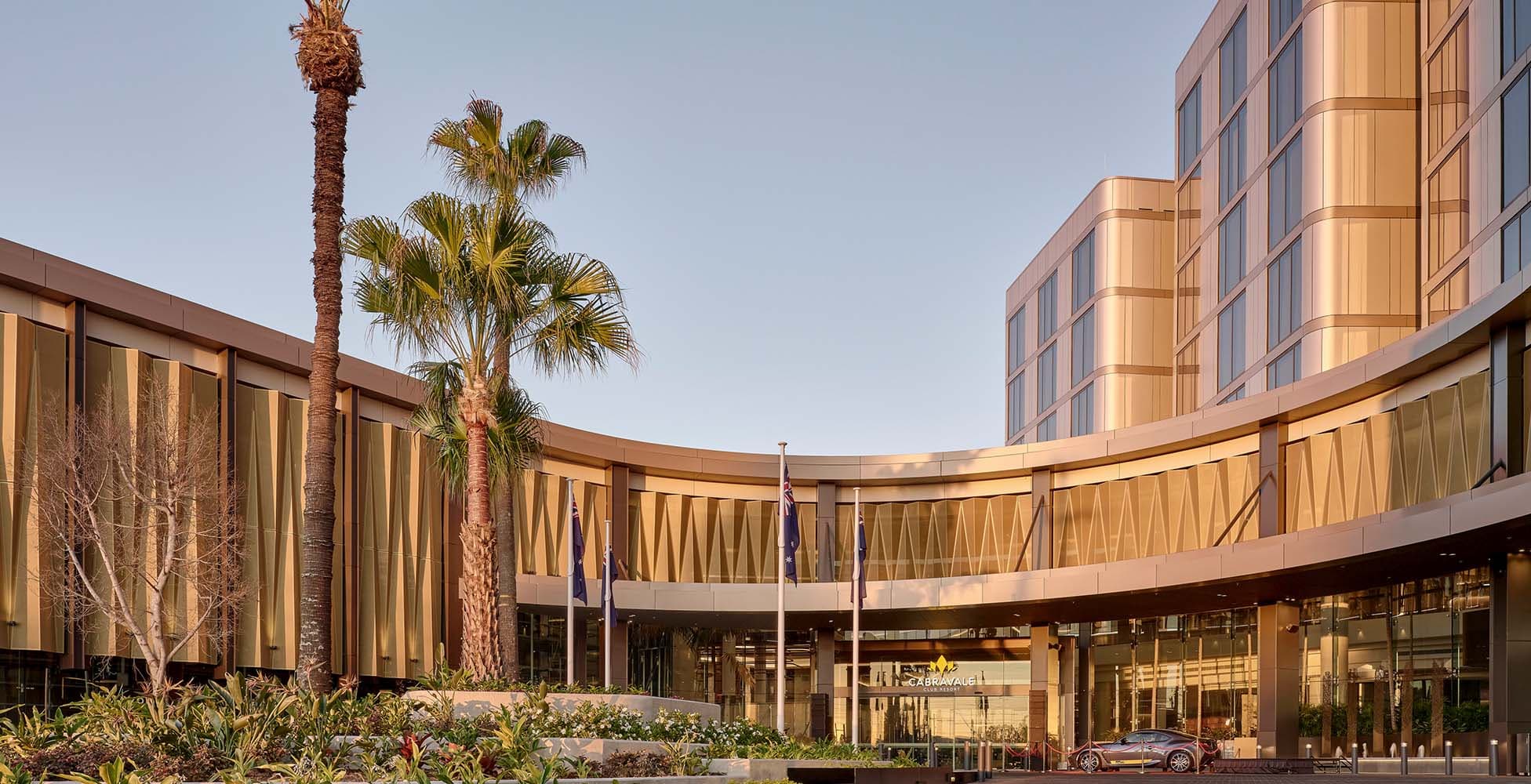
There are club renovations, and then there are projects that rewrite what a registered club can be. The Cabravale Club Resort in Canley Vale is the latter. At $230 million, it is one of the largest club redevelopments ever undertaken in NSW, a ground-up transformation of the century-old Cabra-Vale Diggers Club into a full-service resort with a 140-room Novotel hotel, five dining venues, a new gaming floor, and a 600-seat convention centre.
Phase 1 opened on November 15, 2025, after seven years on the drawing board and four years of construction. The result is a building that looks nothing like the club it replaced. That was the point.
The vision: resort, not renovation
Most club boards approach a redevelopment thinking about new carpet, a refreshed bistro, maybe a refurbished gaming floor. The Cabravale board thought bigger. Their vision was to reposition the club as a genuine hospitality destination, a resort that could compete with the likes of Crown and The Star, but anchored in Western Sydney and owned by its members.
The scope tells the story: a seven-storey Novotel hotel with pool, cabanas, pool bar, and gym. Five distinct dining venues ranging from fine dining to Southeast Asian fusion to an all-day cafe. A completely redesigned gaming floor with 450 machines. Over 1,000 car parking spaces across two basement levels. And a 600-seat convention centre to capture the corporate and events market.
This was not a renovation. It was a new building on the bones of an old one.
The people behind it
A project of this scale does not happen without sustained leadership. The board, led by President Walter Robinson OAM and CEO Boris Belevski, drove the vision over more than a decade of planning and delivery.
| Role | Organisation / Individual |
|---|---|
| Client | Cabravale Club Resort |
| President | Walter Robinson OAM |
| CEO | Boris Belevski |
| CCO | Vicki Le |
| Architect | Altis Architecture |
| Construction Method | Top-down construction |
| DA Reference | DA 446.1/2017 (Fairfield City Council) |
The board itself, Joseph Farrugia (Vice President), Janice Betts, Shane Burette, Anselmo Favaloro, Hank Riedstra, and Lindsay Sharp, maintained continuity through what became a decade-long commitment. That matters. Club boards turn over. When they do, projects stall, scope creeps, and momentum dies. Keeping a consistent group of directors aligned on a single vision for this long is an achievement in itself.
Former General Manager Michael Foulkes, who served the club for 20 years including 16 as GM, was also instrumental in the earlier stages of the project's development before Boris Belevski took the reins.
Planning and approvals
The site at 1 Bartley Street sits on 32,944 sqm of land zoned RE2 Private Recreation under the Fairfield LEP. That zoning permits club uses, but it does not permit a hotel. Getting a 140-room Novotel approved on RE2 land required an amendment to the Local Environmental Plan — a process that added significant time and complexity before a single construction drawing was produced.
The DA (446.1/2017) went through Fairfield City Council and was referred to the Planning Panels Secretariat (PPS-2017SSW049) given the scale of the proposal. Planning documents recorded a project cost of $130 million at the time of assessment, though the final delivered cost reached $230 million. That gap reflects both scope evolution and the realities of delivering a project of this complexity through COVID-era construction.
For boards considering anything beyond a straightforward refurbishment, this is a critical lesson. If your project requires a rezoning, an LEP amendment, or a state-significant assessment, you are adding years to the front end of your program. That time needs to be budgeted, funded, and politically managed.
Design and architecture
Altis Architecture designed the resort, and the result is a building that announces itself. The exterior features a gold perforated metal facade that wraps the podium levels, a material choice that gives the building a sense of permanence and quality that most club buildings do not have. At night, backlighting transforms the facade into a glowing lantern visible from the surrounding streets.
Inside, the design draws on Southeast Asian influences that reflect the local Cabramatta community. The interiors are rich without being gaudy: dark timbers, marble, brass accents, and dramatic sculptural elements in the lobby atrium. Each of the five dining venues has its own distinct identity:
- Magma by Dany Karam — fine dining, a statement restaurant for the resort
- District 8 — a 2,000 sqm Southeast Asian fusion venue, the largest dining space in the complex
- Bistro 1925 — a nod to the club's founding year, positioned as the everyday members' bistro
- Horizon Asian — dedicated Asian dining
- Poppy Cafe — an all-day cafe anchoring the more casual end of the offer
The Novotel hotel rooms are finished to a standard that would sit comfortably in any CBD hotel: custom wallcoverings, quality joinery, and well-considered lighting. The pool deck with its timber cabanas and sandstone walls would not look out of place at a Bali resort.
Staging: building while trading
One of the defining challenges of any club redevelopment is that you cannot simply close the doors for four years. Members need somewhere to go. Gaming revenue, which funds the project, needs to keep flowing.
The Cabravale project addressed this through a four-stage construction sequence:
- Stage 1 — Demolition of the former police building on the site and relocation of the bowling greens, clearing the footprint for new construction
- Stage 2 — Construction of the basement car park, new gaming floor, and auditorium
- Stage 3 — Construction of the seven-storey Novotel hotel tower above the new podium
- Stage 4 — Completion of function areas, conference facilities, and the external facade
This sequencing allowed club operations to continue throughout construction. The gaming floor, which is the engine room of the club's revenue, was relocated early in the program to maintain income while the rest of the building took shape around it.
Parking was also carefully managed. The finished project delivers 1,006 spaces (up from 881), with a two-level basement constructed beneath the hotel tower. Maintaining adequate parking during construction is one of those details that does not make headlines but can make or break member satisfaction during a multi-year build.
Construction method: top-down build
The construction team used a top-down construction method for the basement levels, a technique more commonly associated with deep CBD excavations than suburban club projects. In a top-down approach, the ground-floor slab is cast first, supported on piles, and excavation for the basement levels proceeds downward beneath it. This allows above-ground construction to start earlier, running in parallel with basement works below.
The result: an estimated six months shaved off the program compared to a conventional bottom-up basement sequence. On a $230 million project, six months of avoided holding costs, prelims, and financing charges is substantial.
The project also used modular bathroom pods for the hotel rooms and prefabricated facade panels, both aimed at compressing the construction program and reducing on-site labour in a market where skilled trades were in short supply.
What was delivered
The club celebrated its centenary with a gala on July 16, 2025, and Phase 1 of the resort opened to the public on November 15, 2025. What members and guests walked into was a facility that had no real precedent in the registered club sector:
- Novotel Sydney Cabramatta — 140 rooms across 7 storeys, with pool, cabanas, pool bar, and gym
- Five dining venues spanning fine dining through to casual cafe
- 450 gaming machines on a purpose-built new gaming floor
- 1,006 car parking spaces across two basement levels
- 600-seat convention centre (later phase) for conferences and major events
- Courtesy bus service within a 5km radius
The club has historically donated $1.75 million to the local community and contributes $1.3 million annually through ClubGRANTS. With the additional revenue streams from hotel operations, dining, and events, that community contribution is positioned to grow.
What boards can take away
The Cabravale Club Resort is not a template. Most clubs will never need or be able to fund a $230 million redevelopment. But the principles behind it apply to projects at any scale:
Sustained board commitment matters. This project took more than a decade from concept to opening. Boards that chop and change direction, or lose continuity through elections, will struggle to deliver anything close to this.
Get your planning sorted early. The LEP amendment alone likely added two or more years to the program. If your project needs a rezoning or a change to the planning controls, start that process before you finalise your design.
Stage the work to protect revenue. The four-stage approach kept the gaming floor and core club operations running throughout. Revenue continuity is not optional. It is what funds the project.
Challenge conventional construction methods. Top-down construction, modular pods, and prefab facades are not standard practice in club projects. They saved time and reduced risk. Your builder and project manager should be exploring these options as a matter of course.
Match the ambition to the market. The Cabravale board understood their catchment. Cabramatta and greater Fairfield have a large, diverse, and growing population. The dining offer reflects that community. The hotel captures a market that did not exist in the area. This was not ambition for its own sake. It was ambition calibrated to a genuine gap.
At UpScale, we are currently managing the redevelopment of the Granville Diggers Club, another Western Sydney club navigating its own transformation. If your board is considering a refurbishment, expansion, or full-scale redevelopment, we would welcome the conversation.

Director, UpScale Project Management
Architect-turned-project manager with experience across government infrastructure, commercial, and hospitality sectors. Noel founded UpScale PM to provide independent, client-side advisory for club boards navigating major redevelopment projects across NSW.