Blackwattle Bay redevelopment: delivery risks & staging
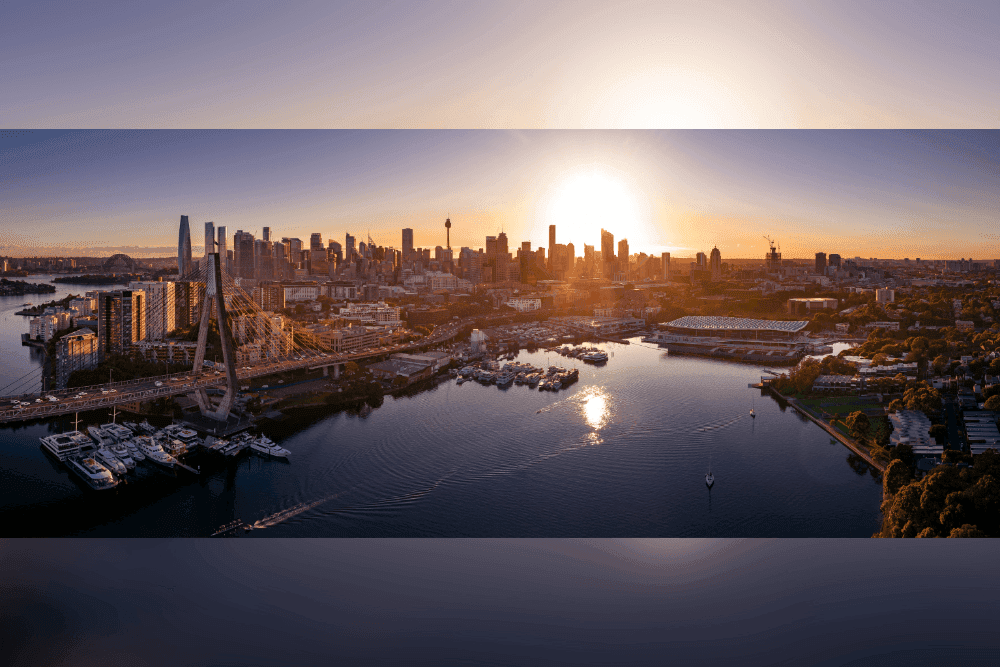
De-risk the Blackwattle Bay redevelopment: lessons from the Bays Precinct, Sydney
Image: Build Australia (https://www.buildaustralia.com.au/projects/nsw-government-unveils-vision-for-blackwattle-bay/)
Introduction
Sydney's inner-city housing and infrastructure pressures are colliding on the waterfront. With Sydney's median dwelling price at $1.6m (Dec 2025, CoreLogic), vacancy rates around 1.2% on the CBD fringe, and population growth tracking +2.1% p.a. (ABS 2025), the NSW Government's target of 377,000 dwellings over five years (2026) has pushed "well-located housing" precincts to the front of the pipeline. Delivery remains constrained by cost escalation (with mixed-use construction costs sitting at $3,500-$4,200/sqm, HIA Q1 2026) and a tight approvals and labour market.
The Blackwattle Bay Redevelopment, part of the wider Bays Precinct renewal, aims to transform the former Sydney Fish Market site into a mixed-use waterfront destination: around 1,400 homes, 26,000 sqm (2.6 ha) of public domain, and a new foreshore link in the 15km Harbour Walk (Woolloomooloo to Rozelle Bay). In March 2026, the NSW Government signed a major contract with Mirvac as delivery partner, with precinct staging planned through to around 2033.
For developers and landowners, the real story isn't the render. It's how staging and interfaces will make or break outcomes.
1. Blackwattle Bay redevelopment milestone: contract clarity, scope clarity
Blackwattle Bay's March 2026 contracting milestone matters because it converts a high-profile vision into a delivery program, one that must integrate housing, public domain, sustainability targets and transport-adjacent logistics on a constrained 3.6-hectare harbourfront site. With Mirvac partnering the NSW Government/Infrastructure NSW, the redevelopment has the governance backbone to move through state-led planning pathways and long-lead stakeholder coordination.
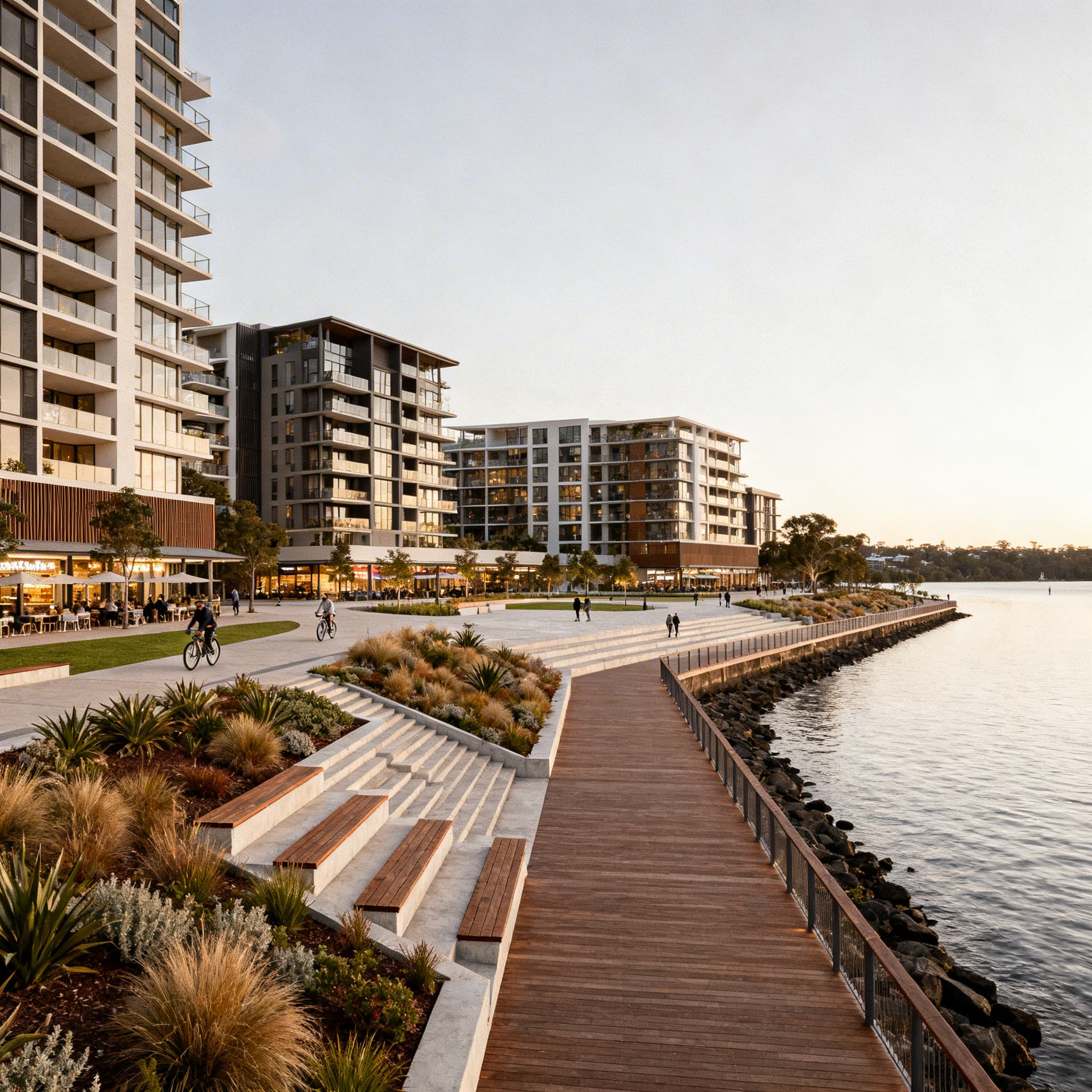
The scope is ambitious: ~1,400 homes (including student accommodation by Scape), retail and commercial uses, and 2.6 ha of public domain, including promenades and a boardwalk that stitches into the 15km Harbour Walk. In today's market, delivering this quantity of well-located supply is directly aligned with the state's 377,000-home target and Sydney's estimated need for ~73,000 dwellings per year.
"We are thrilled to partner with NSW Government to rejuvenate Blackwattle Bay... Mirvac will deliver much-needed housing along with a richly layered foreshore promenade and a boardwalk."
- Campbell Hanan, Mirvac Group CEO
Takeaway: Lock scope and governance early. For any major waterfront renewal, treat the contract milestone as the start of interface definition, not the end of concept design.
2. Precinct staging is the project: boardwalk-first sequencing changes everything
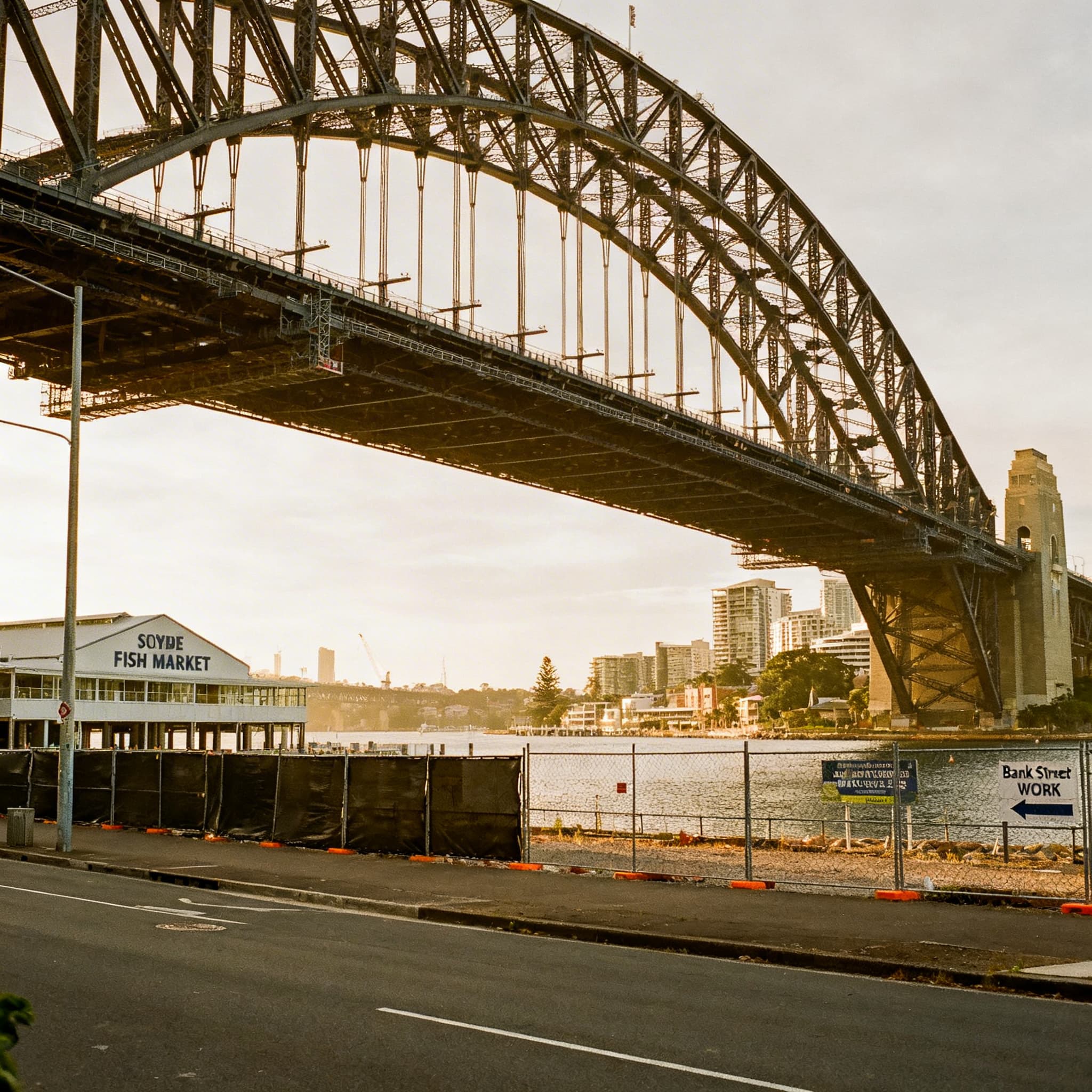
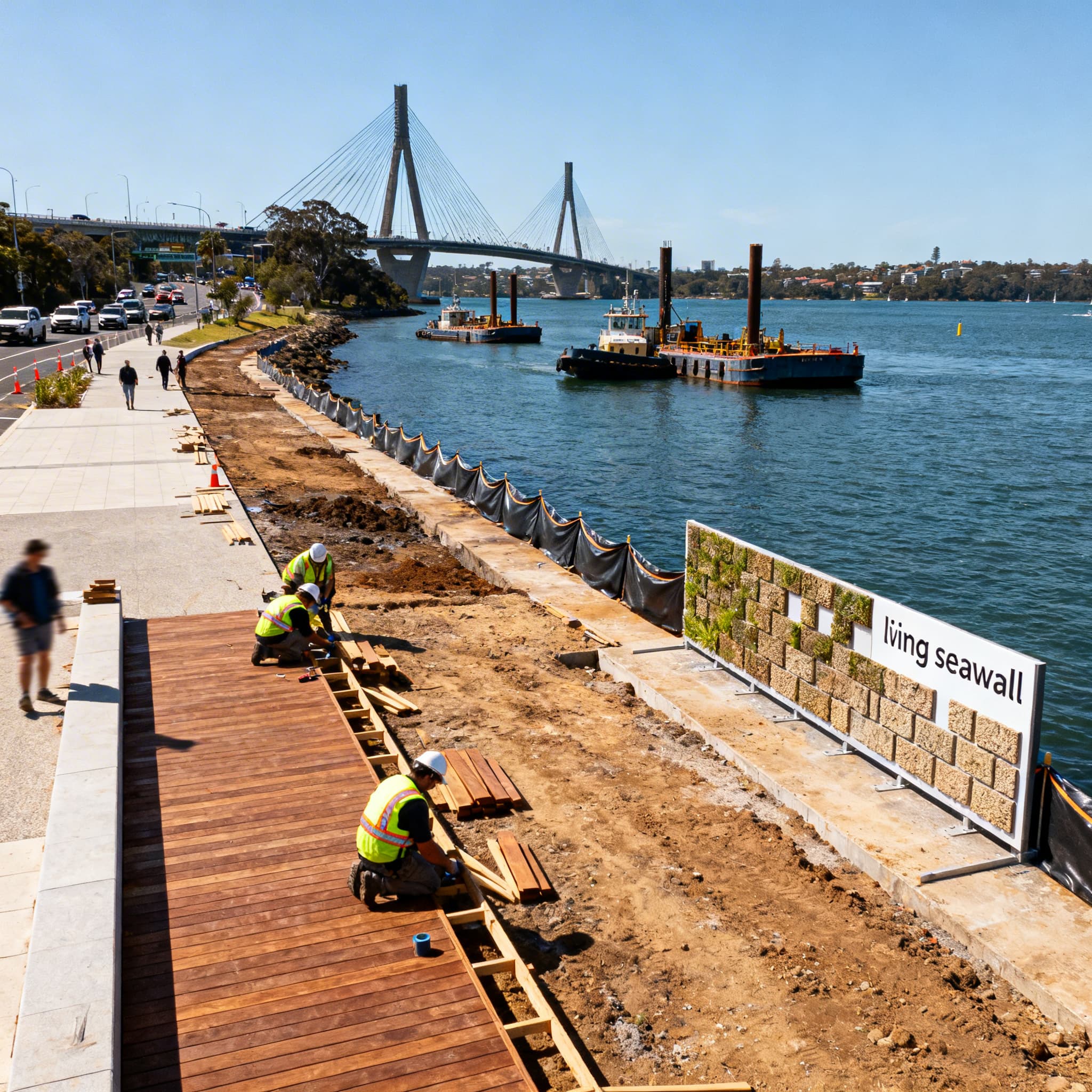
The Blackwattle Bay redevelopment is explicitly precinct-staged: early emphasis on public realm and connectivity (boardwalk/promenade), with main construction expected from early 2027 (subject to approvals and consultation), housing delivery from 2028, and overall completion around 2033. That sequencing is politically and socially smart since people experience benefits earlier, but it is operationally complex for builders and developers because it multiplies temporary works, access constraints and programme dependencies.
Early works are already shaping the site context. Bank Street Park (1.1 ha) under the Anzac Bridge is being delivered by BESIX Watpac, forming part of the precinct's broader public-space commitment (3.4 ha total public space referenced across the renewal works). If your boardwalk and promenade are staged early, you're effectively constructing "front-of-house" assets before the back-of-house logistics are stabilised.
Staging also changes cashflow and feasibility timing. Waterfront mixed-use construction costs of $3,500-$4,200/sqm (HIA Q1 2026), with a 10-15% waterfront premium, mean the decision on what gets built first isn't just a community story. It's a financing and risk story.
"This is an exciting new chapter... turning this once neglected industrial harbourfront into an accessible waterfront."
- Minister Steve Kamper, NSW Minister
Takeaway: Treat staging as a risk register, not a timeline graphic. Every "early public benefit" element needs a logistics plan that won't be demolished or reworked when vertical construction ramps up.
3. Construction interfaces are the hidden schedule killer in the Bays Precinct
Waterfront precincts look open on a render, but they're typically boxed in by assets that cannot move, and Blackwattle Bay is surrounded by them. The redevelopment interfaces with the new Sydney Fish Market (opened January 2026), Anzac Bridge traffic and structural constraints, active public works at Bank Street Park, and a future urban-change wildcard: the Wentworth Park site, where the greyhound lease ends September 2027 and broader rezoning discussions flag potential intensification and new parkland.
This is where interface planning becomes a serious delivery discipline. In our experience, staged precincts can amplify interface risks by 20-30% because every package is effectively working in a live environment: crane placement, hoardings, road occupancy, and even "who owns what" in temporary access corridors. If a boardwalk is delivered early to connect the Harbour Walk, then protected during later tower construction, the temporary works strategy becomes as important as the permanent design.
There's also a market timing overlay: while 15,000 inner-Sydney apartments were underway (Urbis Q4 2025), waterfront precinct delivery often lags due to these exact constraints. If you miss a market window, you don't just lose time. You lose absorption momentum.
"The Minns Labor Government is reviving Sydney's vibrancy, delivering great new public spaces and maximising the opportunity for well-located housing."
- Minister Paul Scully, NSW Minister
Takeaway: Build a day-one interface management plan, including 3D BIM, crane oversail mapping, access protocols, and neighbour MOUs, before finalising the "hero" public domain sequence.
4. The Blackwattle Bay redevelopment must satisfy the harbour premium without breaking feasibility
Blackwattle Bay is a classic Sydney waterfront development equation: exceptional location, high expectations, and expensive delivery. Harbourside land benchmarks have been cited around ~$5,000/sqm (JLL 2025), while construction costs for mixed-use residential sit at $3,500-$4,200/sqm (HIA Q1 2026), before considering waterfront premiums, marine edge treatments, and sustainability inclusions.
The precinct's promise goes beyond housing numbers. It's a "Sydney-grade" public realm: 26,000 sqm of public domain, parks, promenades, and the Harbour Walk connection. Those elements create value, but they also create non-negotiable obligations, often delivered early, held to higher finish standards, and exposed to weather and maritime conditions during construction. Add a net zero ambition (targeting net zero carbon by 2030) and initiatives like living seawalls, and you have cost drivers that require disciplined scope control and procurement packaging.
This is where product mix can de-risk feasibility. Student accommodation (Scape) can stabilise returns and reduce reliance on pure pre-sales at a time when the RBA cash rate was 4.35% (March 2026) and end-buyer lending costs remain elevated. Put simply: you don't "value engineer" the foreshore, so you must structure the rest of the project to carry it.
"We are thrilled to partner with NSW Government to rejuvenate Blackwattle Bay..."
- Campbell Hanan, Mirvac Group CEO
Takeaway: For waterfront feasibility, lock public-realm scope early and de-risk the balance through product mix (e.g., BTR/student housing), packaging, and realistic cost premiums for marine and sustainability works.
5. DA strategy and consultation loops: state-led doesn't mean frictionless
Blackwattle Bay will progress via a state-led pathway (Infrastructure NSW oversight), which can reduce the risk of local delay, especially as the Minns Government signals willingness to intervene on "well-located housing" when councils stall. But state-led does not mean "set and forget". The project already shows how consultation reshapes outcomes: a prior vision (FJMT) was revised toward lower heights/density in response to community feedback on affordability and public space.
From a delivery-risk perspective, consultation isn't a box-tick exercise. It's a programme variable. For major precincts, budget 6-12 months for iterative design changes, stakeholder alignment and approval sequencing. If you don't, you end up compressing procurement, issuing design information late, and paying for acceleration (or absorbing delay claims).
On a long-horizon project running to ~2033, small approval shifts compound. A staged programme also means you may seek approvals in tranches, and each tranche can re-open design debates. Meanwhile, cost inflation pressures persist: Master Builders has flagged ~12% cost inflation in 2026, so time is literally money.
"This is an exciting new chapter... turning this once neglected industrial harbourfront into an accessible waterfront."
- Minister Steve Kamper, NSW Minister
Takeaway: In the Blackwattle Bay redevelopment (and any Bays Precinct project), plan approvals like a delivery package: allow real time for consultation-driven redesign, and align DA staging with procurement strategy to avoid cost blowouts.
Conclusion
The question for the Blackwattle Bay redevelopment isn't whether Sydney needs it. Sydney clearly does, with 73,000 dwellings per year required and a vacancy rate around 1.2% in the CBD fringe. The question is whether a high-profile, staged waterfront renewal can be delivered without interface-driven delays, rework, and feasibility drift as the project runs toward ~2033.
Blackwattle Bay shows the modern Sydney reality: public realm must be delivered early, housing must be well-located, and construction must happen next to operating city infrastructure. The winners will be the teams that treat precinct staging and construction interfaces as first-order design inputs, on equal footing with architecture and public domain.
- Stage with intent: Boardwalk-first programmes need "protect-and-build-around" logistics from day one.
- Manage interfaces like contracts: Neighbour MOUs, 3D coordination, access protocols and possession plans reduce delay risk.
- Model feasibility with real premiums: Waterfront costs, sustainability scope and consultation time must be priced, not hoped away.
If you're assessing a site within the Bays Precinct or any Sydney waterfront development, now is the time to build a delivery-led feasibility and approvals strategy, not just a concept.
UpScale PM specialises in project feasibility, DA strategy, and premium project delivery. Lets build something iconic - together.
Call us on 02 9090 4480 to chat through your site opportunity.

Director, UpScale Project Management
Architect-turned-project manager with experience across government infrastructure, commercial, and hospitality sectors. Noel founded UpScale PM to provide independent, client-side advisory for club boards navigating major redevelopment projects across NSW.